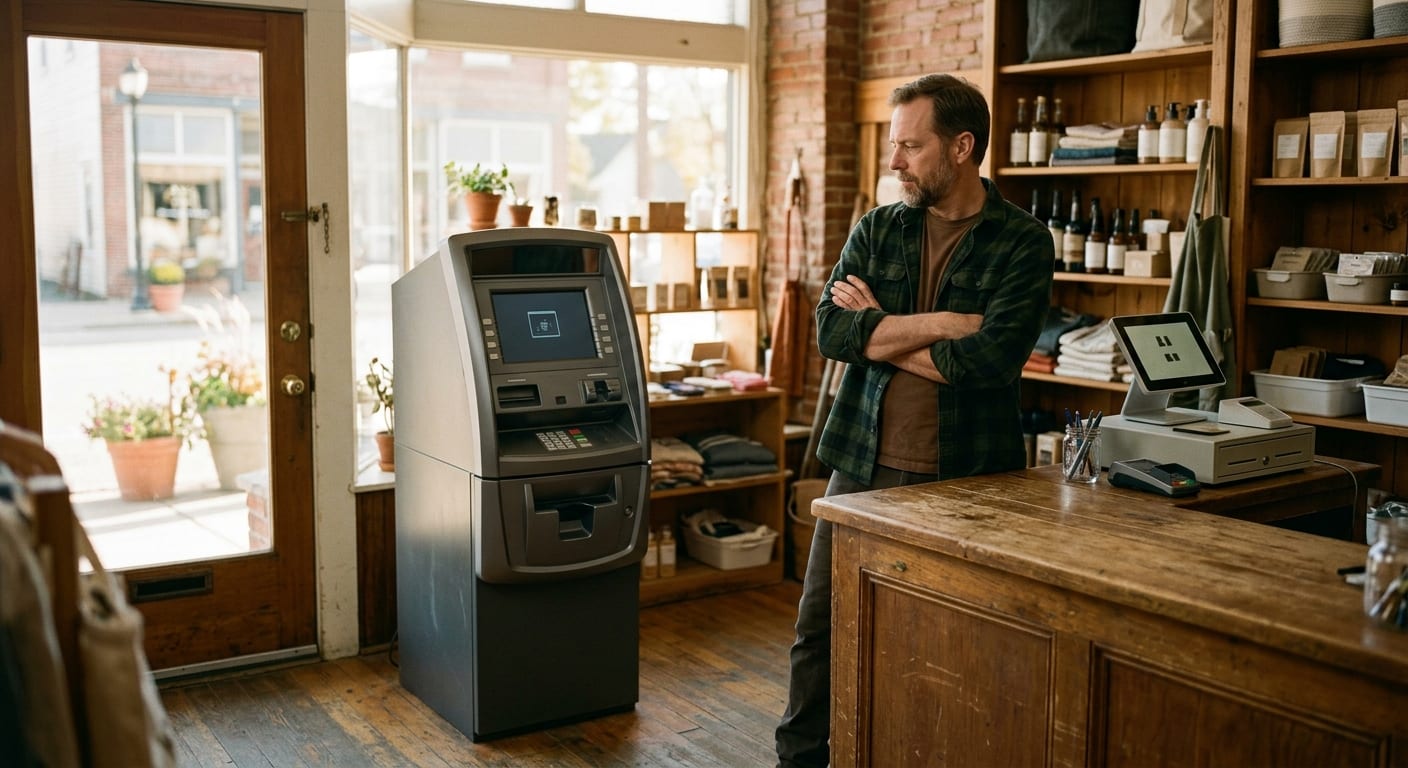
A cashless ATM dispensary is a workaround at the register, not card processing. The device is registered as cash-access equipment, routes over debit networks on that basis, and the amount arrives labelled as money handed to the cardholder. Network rules do not allow that coding, and the merchant carries the consequences.
What a cashless ATM is doing, in plain terms
The customer slides a debit card, enters a PIN, and walks out with product. From the counter, it looks like ordinary debit. It is not.
A cashless ATM is registered as cash-access equipment. The transaction routes over debit networks on that basis. The amount arrives labelled as money handed to the cardholder. No vault opens. No bills come out. The ticket at the register is a sale. The networks treat it as cash already handed to the customer.
That gap is the whole pitch. The shop gets the look of card checkout without a merchant account that describes the business. The customer’s statement shows cash access, or something close to it, instead of a store name and a purchase. Staff still bag the order. The coding does not match the counter.
A real ATM holds vault cash and dispenses bills. The customer then pays the register with those bills. The network sees cash access because cash actually moved. A cashless unit skips the cash and still uses that path.
If someone means a bank app that pulls cash with a phone and no plastic, that is a cardholder product at a bank’s own machines. It is not a terminal on your floor. A cashless ATM system in a shop is a retail sale routed as cash access.
We do not sell these devices. We do not call them card acceptance. The longer version of this warning lives on our cashless ATM risks page.
Why this is a risk, not a grey area
The transaction is coded as something it is not. Network rules do not allow it. There is no grey version of that sentence.
Cannabis remains a federally scheduled substance under the Controlled Substances Act. That is why the major card networks do not carry plant-touching sales the way they carry ordinary retail. A cashless ATM does not change the product in the bag. It changes the label on the message that travels the networks. The sponsor bank and the processor still have to live with what that message claimed.
Underwriting reads the business, the category, and the way tickets settle. A sponsor bank cares about the merchant category code because that code is how the networks sort risk. Asking which code applies, and getting the answer in writing, is the honest framing. A cashless ATM system is built to skip that conversation. It borrows the cash-access path so the sale does not have to stand as a sale.
Miscoded accounts and disguised transactions get frozen, and the merchant absorbs the loss. Stripe, Square, and PayPal ban hemp and CBD outright in their published policies, and most merchants who arrive here were shut off by one of them. Check each provider’s own current policy page, because those terms change. A cashless unit is a different disguise aimed at a different door. The file stops matching the floor, and someone upstream cuts it off.
We will not set one up. We will tell you straight. Anyone selling the machine as a bridge until the networks catch up is selling you delay.
Who eats the loss when the arrangement unwinds
The merchant absorbs the loss. That is the line the sales pitch skips.
When a miscoded account is frozen, deposits stop. Tickets already run may be held or reversed. The customer already left with the product. You cannot un-ring a Saturday. Cash flow takes the hit first. Then you read the contracts. Agreements in this category push network trouble downstream. The bank answers to the networks. The processor answers to the bank. The company that placed the machine answers to the processor. The shop is the last name on the chain.
You will be told the vendor handles compliance. Read the indemnification clause anyway. If the coding is wrong, the people who collected a placement fee are rarely the people who make payroll. Frozen deposits and a dead terminal on a Friday night land in one place: your till.
The customer tapped a PIN and expected a purchase. They may see a cash-access description on a statement and call their bank. A cashless ATM is not a merchant account, so you do not get a clean statement to audit. You cannot sort this mess from an ordinary processing file.
Rooted Payments is an independent payments brand. We place shops with processing and point-of-sale that can hold up under underwriting. We put the cost structure in writing before you commit. We are not a bank, not a lender, not an acquirer, and not an underwriter. Approval is the sponsor bank’s decision. Anyone who guarantees the opposite in this category is guessing or lying.
What to ask before anyone wheels a machine onto the floor
Do not wheel it onto the floor. That is the answer, and it should be the end of the meeting.
If a salesperson is already in the lobby, make them put the routing in writing. Get the merchant category code on paper. Never accept “it’s just like debit” as a substitute. Get how the amount will appear on the cardholder’s statement. Get the sponsor bank’s name, and who pays if that bank is told the coding is wrong. Get what happens to deposits already in flight if the terminals are shut off.
Those asks are how you watch a pitch collapse, not a shopping list. A real merchant account can name the code, the bank, and the cost structure. A cashless ATM system talks about speed and shorter lines. Speed is not a category code.
The written code is the only way you can later prove what you thought you bought. Verbal promises from a salesperson evaporate when a risk team opens the file. If they cannot put the sponsor bank and the coding on one page, there is nothing to underwrite.
Bring the same file you would bring to a real application: three months of processing statements if you have them, your licenses, and the certificates of analysis that match what you sell. If the vendor does not want that file, they are not placing you. They are installing a device.
Real card acceptance versus a workaround at the register
Real card acceptance is a merchant account that describes the business, settles under a disclosed category, and can survive the sponsor bank’s review. A workaround is a sale dressed as cash access. Those are not two flavors of the same checkout.
Licensed cannabis is the hard case, because plant-touching sales are why the major card networks stay out. If you are asking whether a shop can take cards at all, start with whether dispensaries can take credit cards and our page on dispensary payments. The honest version names who decides: the networks, the sponsor bank, and your state’s regulator for the license itself. We do not get to rewrite that stack.
Paying without cash, when it is actually available, means a disclosed merchant account, PIN debit processed as a purchase, cash, or a real dispensary POS tied to honest tender. Staff should be able to tell a customer, in one sentence, how they paid. If the only honest sentence is that it runs like an ATM but nothing comes out, you already know.
We place hemp, CBD, smoke, vape, kratom, and licensed cannabis-adjacent retailers with processing and point-of-sale that can hold up under underwriting. We explain the cost structure in writing. We will not dress a sale as cash access. No honest answer to “will I definitely be approved” is yes. If you want that conversation, use the contact page or call (844) 860-5505.
Frequently asked questions
What is a cashless ATM? A terminal registered as cash-access equipment that routes a retail sale over debit networks as if money had been handed to the cardholder, even though no vault cash moved.
How does a cashless ATM work at a dispensary? The customer uses a debit card and a PIN at a unit beside the register, the shop treats the result as payment for product, and the networks receive a cash-access message instead of a disclosed retail ticket.
How do I pay at a dispensary without cash? Where real processing exists, it is a merchant account that describes the business. Cash, disclosed PIN debit as a purchase, ACH, and gift cards are honest tenders. Card networks still do not carry plant-touching sales the way they carry ordinary retail.
Does Rooted Payments sell cashless ATMs? No. We do not sell them, we do not call them card acceptance, and we will not set one up. Miscoded accounts and disguised transactions get frozen, and the merchant absorbs the loss.
Can I withdraw from an ATM without a physical card? That is a bank’s own cash machines and a cardholder app. It is not a shop-floor cashless ATM, and it is not a way to run a dispensary sale.