Common questions. Straight answers.
What hemp, CBD, smoke shop and dispensary owners ask us first. If yours is missing, send it through the contact form.
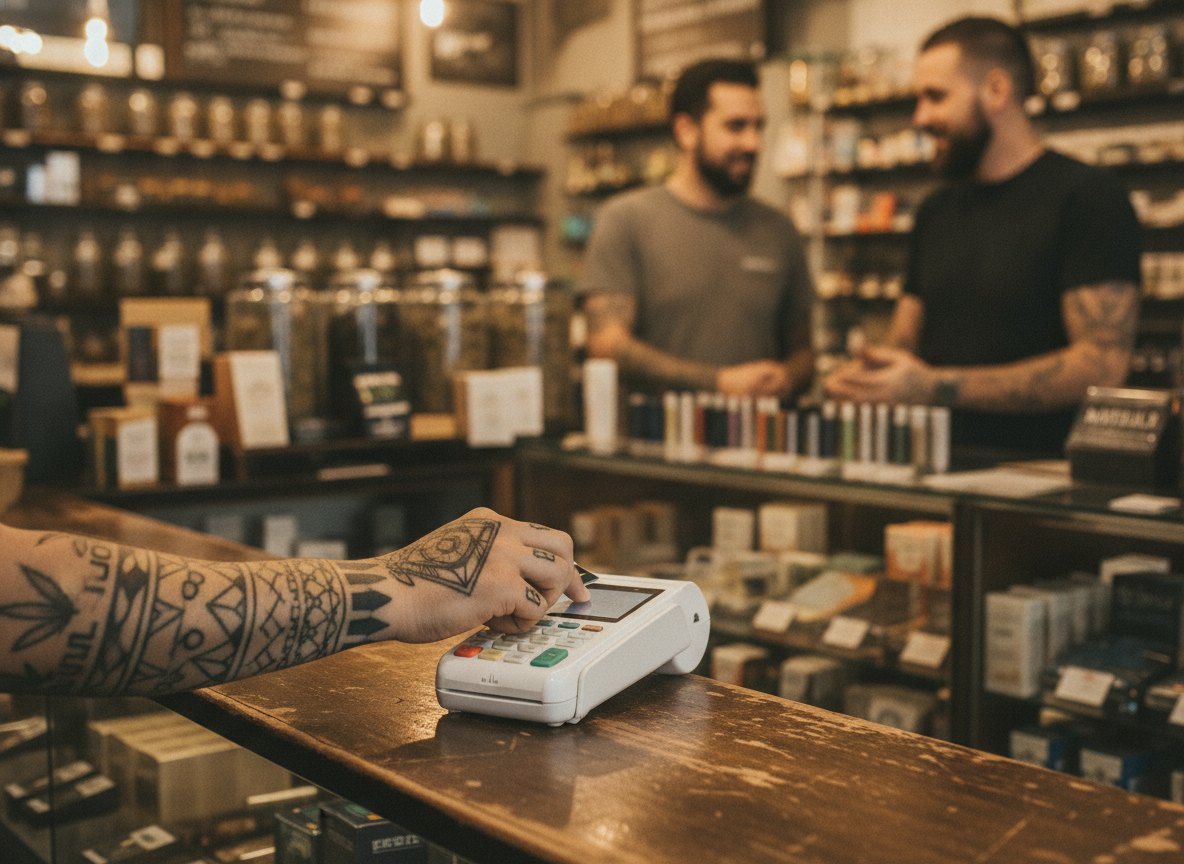
Cannabis and dispensaries
Can dispensaries take credit cards?
In most states, no. Cannabis is still federally scheduled, so the major card networks will not carry plant-touching sales. Shops mostly run cash, debit workarounds, or ACH. We say what is actually available rather than selling you a story.
Do you sell cashless ATMs?
No. A cashless ATM is not card acceptance. It codes the sale as a cash withdrawal at the register, which misrepresents what happened. Card networks have taken enforcement action on exactly that, and the merchant is the one who loses the account and the money in it.
What payment options does a licensed dispensary actually have?
Cash with proper handling, PIN debit through a compliant program where the sponsor bank allows it, ACH and pay-by-bank, and closed-loop wallets. Each has trade-offs. We walk through them on our dispensary payments page instead of pretending one is a clean card solution.
Is hemp legal to sell?
The 2018 Farm Bill removed hemp from the federal controlled substances definition, provided the product stays at or below 0.3% delta-9 THC on a dry weight basis. State law still varies, and some states restrict specific hemp products outright. Check your state before you build a storefront around it.
CBD and hemp accounts
Why did Stripe, Square or PayPal shut down my CBD account?
Because their published policies ban CBD, and they enforce them by termination rather than by warning. Those companies are aggregators. They put thousands of merchants under one master account, so a category they consider risky gets removed instead of underwritten. It is a policy decision, not a judgment about your business.
What is a high-risk merchant account?
It is a merchant account underwritten individually, with a bank that has agreed to accept your category. You get your own merchant ID instead of sharing one. Underwriting is slower and pricing runs higher than an aggregator, but the account is yours and it does not vanish when a policy sweep runs.
Can I take cards for CBD and hemp products?
Usually yes, through a processor and sponsor bank that board the category deliberately. That is the part most owners are never told after an aggregator shuts them off. Compliant lab reports, accurate product claims and clean marketing all matter to the underwriter.
Can you promise my account will be approved?
No, and nobody honestly can. Approval is the sponsor bank underwriting decision, not ours. Anyone in this category who promises you an outcome is either guessing or selling. What we can do is tell you before you apply whether your business looks boardable, and what would need to change if it does not.
Underwriting and applying
What do underwriters ask for?
Expect business formation documents, a government ID for the owners, several months of bank statements, and processing statements if you have them. For hemp and CBD, expect certificates of analysis, supplier documentation, product labels and a review of your website claims.
What gets an application declined?
Health claims on your site are a common one, since implying a product treats or cures anything draws attention from the FDA and from underwriting. Others include unclear ownership, a heavy chargeback history, missing lab documentation, and selling into a state that restricts your product.
What should I fix before applying?
Clean up product claims, publish real refund and shipping policies, make sure your age gate works, and get your lab reports organized and current. Every one of these is checked, and every one is easier to fix before an underwriter finds it.
Fees and pricing
What is the difference between interchange plus and a flat rate?
Interchange plus passes through the card networks' actual cost and adds a stated markup on top, so you can see what the processor keeps. A flat rate charges the same way on every card and folds the markup out of sight. Flat is simpler to read. Interchange plus is easier to audit. Which one costs less depends on your volume and card mix.
What is tiered pricing?
Tiered pricing sorts your transactions into buckets, usually qualified, mid-qualified and non-qualified, and charges each bucket differently. The processor decides which bucket a transaction lands in, and your statement does not show the sorting logic. The rate you were quoted is the cheapest bucket, and rewards cards and keyed-in sales tend not to land there.
How do I compare two processing quotes fairly?
Work out the effective rate for each. Add every processing cost for a month, including monthly and per-item fees, and divide by total card volume. Quoted rates leave fees out, so two offers can look identical and cost very differently. The effective rate is the only figure that survives the comparison.
What is a rolling reserve?
A share of your deposits held back for a set period to cover chargebacks that might arrive later. A rolling reserve releases each batch as its hold expires, so it settles into a permanent lag on part of your cash flow. Reserves are common in high-risk boarding. Ask whether one applies, what share and for how long.
Can I charge my customers the processing fee?
Surcharging and cash-discount programs exist and they are regulated. Card network rules and some state laws govern what you can charge, how you disclose it and how it appears on a receipt. It is a real option that has to be set up properly rather than simply switched on. Ask and we will explain how it would work at your counter.
Why is there no pricing on your website?
Because we have no rate card, and publishing a number we cannot stand behind would be a lure rather than a price. Cost depends on your category, volume, average ticket, card mix and how a sponsor bank reads your risk. We put your numbers in writing once we have seen your statements.
Chargebacks and risk
What is a chargeback, and how is it different from a refund?
A refund is you returning money to a customer. A chargeback is the customer going to their card issuer instead and having the payment reversed. You lose the sale, you usually pay a fee, and the dispute counts against your account regardless of who was right.
What is friendly fraud?
A cardholder disputes a charge they genuinely made, sometimes because they forgot the purchase, did not recognise the descriptor on their statement, or found disputing easier than requesting a refund. It is the most common dispute type in card-not-present retail, and a clear billing descriptor and reachable customer service prevent a surprising share of it.
Why does my chargeback ratio matter so much?
The card networks publish thresholds, and crossing them puts an account into a monitoring program with extra costs and requirements. Sustained breaches can end the account entirely. In high-risk categories there is less tolerance to spare, so the ratio deserves attention long before it becomes a problem.
How do I reduce chargebacks?
Make your billing descriptor recognisable, answer customer messages quickly, describe products accurately, keep delivery evidence, and refund promptly when a complaint is fair. Most disputes are a customer service outcome before they are a fraud outcome.
Can I fight a chargeback?
Yes. You respond with evidence, which is called representment: the order record, delivery proof, your terms, and any correspondence. It has a deadline and it is worth doing on disputes you can document. It is not worth doing on the ones you cannot, and knowing the difference protects your ratio.
Accounts, gateways and getting paid
What is the difference between a payment gateway and a processor?
The gateway is the doorway your online checkout talks to. The processor moves the transaction through the card networks. The acquirer, or sponsor bank, is the institution that actually holds your merchant account and accepts the risk. An aggregator bundles all three and puts you on a shared account, which is why it can remove you by policy.
Why do I need my own merchant account instead of an aggregator?
Because a dedicated merchant account is underwritten for what you actually sell. Someone reviewed your products and approved them before you processed anything, so your business is not a policy violation waiting to be noticed. You also get your own merchant ID and funds settling to your own account rather than out of a shared pool.
How long until money reaches my bank?
Settlement usually runs on a business-day cycle after your batch closes, and weekends and holidays extend it. High-risk accounts sometimes carry a longer funding delay or a reserve, which changes the answer materially. Ask for the funding timetable in writing, because it affects your working capital more than the rate does.
What documents does an application need?
Typically business formation documents, ownership identification, recent bank statements, recent processing statements if you have them, your website, and for hemp and CBD your product labels and third-party lab reports. Having them assembled before you apply is the single biggest thing you control about how smoothly it goes.
Can I take payments online and at the counter on one account?
Usually yes, and most of our retailers do. Card-present and card-not-present carry different risk and different cost, so they may be priced differently, but they can sit under one merchant account with a gateway attached for the online side.
What happens if my account gets frozen?
Ask in writing for the reason and the specific policy cited, export your transaction history and customer records immediately, and find out whether funds are held and for how long. Then start a proper application somewhere that underwrites your category, because an aggregator that terminated once will not reinstate you. We can start that while you are still sorting out the first account.
POS, pricing and how we work
Do you do point-of-sale as well as processing?
Yes. Most retailers in this category need both, and the two decisions affect each other. We cover the register, age verification at checkout, inventory and how the processing sits behind it.
What does it cost?
It depends on the business, and we will not publish a number that pretends otherwise. Cost is driven by your category, your volume, your average ticket, your chargeback history and your hardware. We put a written quote together for your specific business, and you see the full structure before you commit to anything.
Are you a bank?
No. Rooted Payments is an independent payments brand. We are not a bank, not a lender, and not the processor of record. We connect merchants with processing and point-of-sale, and the account itself sits with the processor and its sponsor bank.
What if my business is not boardable?
We tell you, and we tell you early. Sending a hopeless application through underwriting wastes your week and burns a bank relationship. If there is a version of your business that is boardable, we will explain what that looks like.
Longer answers
Some of these deserve more than a paragraph. We wrote them out in full.
Find out where your business can actually board
Tell us what you sell and where you sell it. A Rooted Payments specialist reads it back to you straight, including when the answer is no.