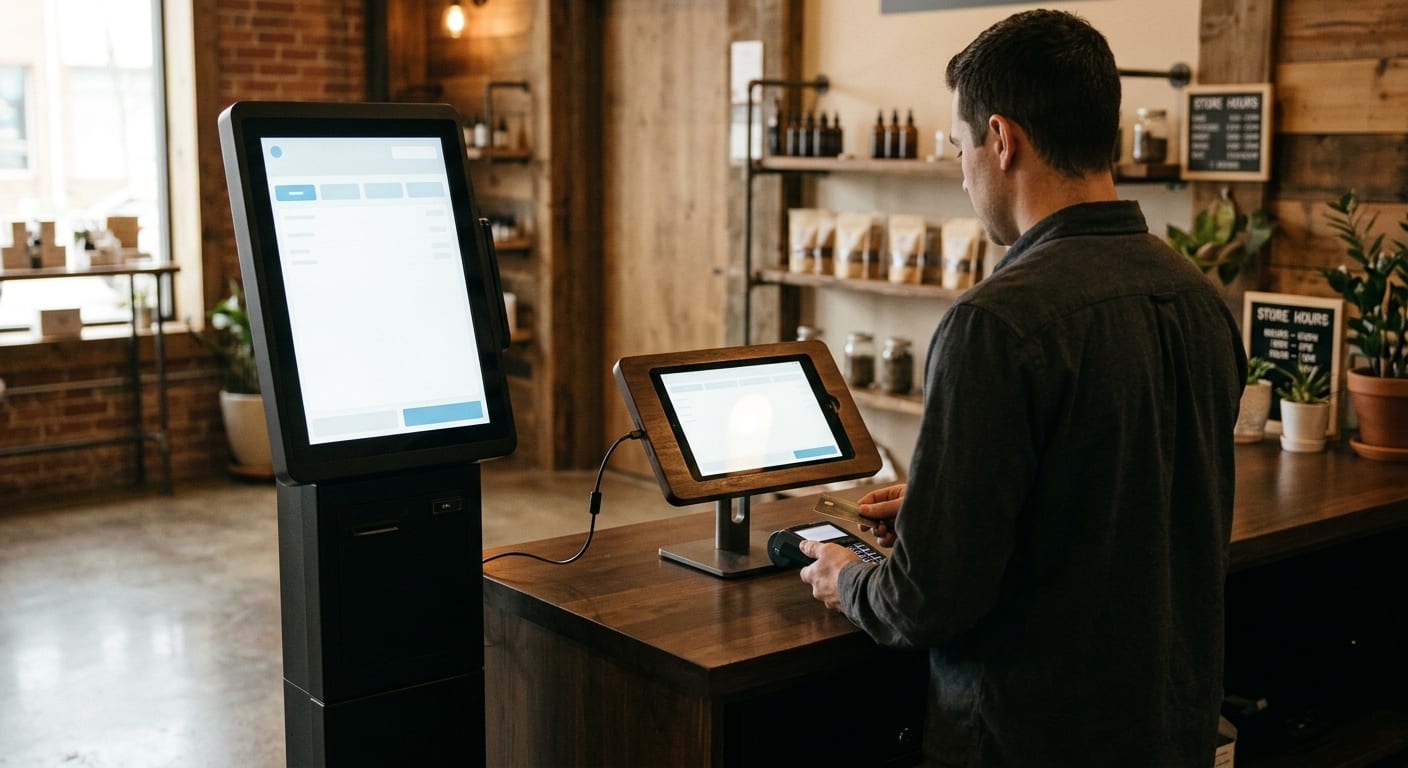
A dispensary kiosk POS integration is the job of keeping one sale together when the customer is not standing at the clerk’s screen. The kiosk is a front. The POS is the system of record. If the age check, the inventory drop, and the tender do not land on the same ticket, you are running two shops that only look like one.
The kiosk is a front, the POS is the system of record
Walk into a licensed shop and you will see two kinds of screens. One faces the customer. One faces the budtender. People treat the floor unit as checkout because it is tall and it has a card slot. It is not checkout. Checkout is whatever writes the ticket, drops the units, and records the tender.
A kiosk can be a menu, a queue, a dispensary check-in kiosk, or a self-checkout lane. The cabinet does not decide that. The software path does. If the kiosk prints a number and the clerk rebuilds the cart on a tablet, the kiosk never talked to the POS. It talked to the customer.
That is why our kiosk versus tablet POS piece is a form-factor question. This one is the wiring. A floor unit and a counter tablet can share one system and behave like one register. Two pretty screens with two carts and a shared Wi-Fi network are not that.
The dispensary POS is the place you go when a customer comes back, a package is short, or someone asks what left the building. If that answer lives in two databases, neither one is the record. In the demo, ask which database writes the sale. Then ask which screen can void it.
Budtenders will work around a slow kiosk. They will ring the same customer twice if the kiosk cart never appears on the register. That is not a training problem. That is a split ticket, and it will show up in the drawer before it shows up in a vendor slide.
Age checks, inventory, and payments have to stay in one sale
Three things have to finish together: the age check, the inventory decrement, and the tender. Miss one and the ticket is fiction.
Age verification belongs on the sale, not on a clipboard at the door that never meets the cart. A check-in scan that forgets the result at the register is a lobby gadget. The clerk should see a pass or a fail on the same ticket they are about to tender. We do not write your state’s rule for you. Your regulator does. Your own counsel does. Check them.
Inventory is the same shape. The unit has to leave on-hand when the sale posts, not when someone remembers to sync. If the kiosk decrements a local list and the POS decrements a different list, you will sell the last jar twice. In states that require traceability, reporting is a condition of holding the licence, not a feature you opt into. Tag formats and deadlines come from the regulator, not the kiosk vendor. METRC integration is the POS talking to that tracker. The kiosk should not keep a private count. Hemp products are not tracked in those systems the way licensed cannabis is.
The tender has to land on that same ticket. Cash in the drawer, a debit path a sponsor bank will actually underwrite, a gift card the POS issued. A kiosk that takes payment on a side device and never writes it back is not integrated. It is two checkouts stacked in one cabinet.
Cannabis remains a federally scheduled substance under the Controlled Substances Act, which is why the major card networks do not carry plant-touching sales the way they carry ordinary retail. A kiosk does not change that. If a demo solves cards with a cashless ATM, walk. The transaction is coded as something it is not, and the merchant carries the consequences. We do not sell those devices. Read our page on cashless ATM risks before you bolt one to a kiosk.
What breaks when the kiosk and the register disagree
The moment to watch is simple. The customer pays at the kiosk, walks out, and the register still shows the cart as open. Or the register shows paid and the jar is still on the shelf count. Or the door scan passed and the ticket has no ID event on it.
That is the break. Not a frozen screen. A sale that does not exist in the place you count as true.
When the two sides disagree, staff pick a winner by habit. Some shops trust the kiosk because the customer already left. Some trust the register because that is where the drawer sits. Both habits write a shadow inventory. At close, the drawer and the report will not match, and nobody can say which sale was the ghost.
Voids get ugly fast. A kiosk void that never reaches the POS leaves a paid ticket with no product movement, or a product movement with no tender. A register void that never reaches the kiosk leaves the floor unit offering a jar you already pulled. If check-in assigns a place in line and the budtender’s screen never receives that person, you bought a sign.
Offline mode is where vendors hide. Ask what happens when the floor unit loses the network for ten minutes: a queued replay, a blocked sale, or a local ticket the POS will never see. A blocked sale is annoying. A silent local ticket is a hole in the day.
A sponsor bank underwrites the business as it actually runs. It is not impressed by a cabinet. It cares whether the category is described honestly and whether the processing path matches the goods. Two systems that cannot agree on a ticket are an operations problem first. They become a payments problem when deposits stop matching your batches.
Hardware you can swap without ripping out the shop
Cannabis dispensary kiosk hardware is the cabinet, the scanner, the printer, the ID reader, and the payment device. The shop is the POS, the inventory file, the employee logins, and the reporting. You want to replace a cracked screen without rebuilding the catalog.
That is the test. If the kiosk is a closed appliance that stores its own products, swapping it means rekeying every SKU. If the kiosk is a client of the POS, the cabinet is furniture. Furniture you can swap.
Readers, cameras, and cash drawers fail. They fail on a Saturday. The replacement should pair to the same ticket, not open a second merchant file. Terminals and readers get bought outright, leased, or bundled. A lease is often the most expensive way to buy the cheapest device. Get that structure on paper before you commit. We put the full cost structure in writing before a merchant commits.
Do not let a hardware vendor talk you into a workaround. A kiosk that needs a miscoded merchant category code, a shell entity, or a cashless ATM to take cards is not a hardware choice. Miscoded accounts and disguised transactions get frozen and the merchant absorbs the loss. We will not set one up.
Ask what mounts to the pole and what lives in the POS. Ask whether a counter tablet can run the same sale if the floor unit is down. That fallback is how you tell a real system from a pretty box.
How to judge a demo without buying the pitch
Ignore the rendering of the cabinet. Watch one sale, start to finish, on both screens.
Have them scan an ID at the kiosk. Put two items in the cart, including a weighted flower SKU if that is how you sell. Pay. Then walk to the register before anyone clicks around. The ticket should already be there, closed, with the age event, the units gone, and the tender named.
Then void it from the register and watch the kiosk. Then sell the same cart at the counter tablet and watch kiosk inventory. If either side lags until someone hits refresh, you are looking at two lists.
Make them do both of these in the room:
- Run a sale at the kiosk and confirm it is closed on the register before anyone taps refresh.
- Pull the network on the floor unit and see whether the next sale queues, blocks, or writes a ticket the POS will never see.
If they will not do that live, the pitch is the product.
Bring three months of processing statements if you have them, plus your certificates of analysis and a clean description of what you sell. That is what a placement conversation uses. We match the shop to processing and point-of-sale that can hold up under underwriting. We do not approve accounts. The sponsor bank does.
If you want the cost structure in writing first, start on our contact page. We will tell you straight what the file has to show.
Frequently asked questions
What does dispensary kiosk POS integration actually mean? It means the kiosk and the POS share one ticket. Age check, inventory decrement, and tender post together, on the same sale, without a clerk rebuilding the cart.
Can I swap cannabis dispensary kiosk hardware without replacing the POS? You can if the kiosk is a client of the POS and the catalog lives in one place. If the cabinet stores its own products, a hardware swap is a recatalog.
Does a dispensary check-in kiosk have to be the same vendor as the register? It has to share the sale. Same vendor is one way to get there. A documented handoff onto the same ticket is the test, not the logo on the bezel.
What if the kiosk takes cards and the register takes cash? Both tenders still have to land on the POS ticket. A side device that never writes to the sale is a second checkout, even if it is bolted to the same stand.